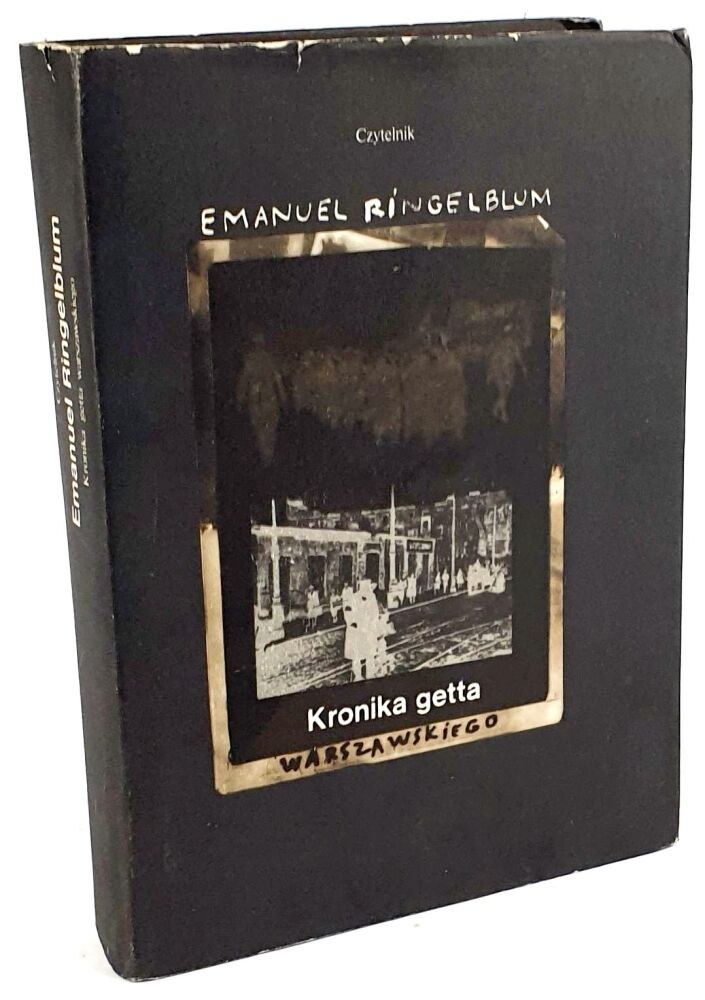
RINGELBLUM Emanuel
CHRONICLE OF THE WARSAW GHETTO
Introduction and ed. by Artur Eisenbach ; translated from Yiddish by Adam Rutkowski ; compiled. and supplied with footnotes by Tatiana Berenstein et al ; scholarly consultation. Tomasz Szarota ; excerpts from "Silhouettes" transl. Michal Friedman
Warsaw 1983, Czytelnik, pp. 644, 24 k. plates with illustrations ; format 15x21 cm
Excerpt:
August 26, 1941.
Lately a strange indifference to death has been noticeable and no longer makes an impression. People pass the dead indifferently. Few people come to hospitals to learn about their relatives. Also in the cemetery, rarely anyone takes an interest in the dead. Next to the famine, typhus has become the most pressing issue gripping the attention of the entire Jewish society. Today it is the most pressing issue. The (epidemic) curve of typhus keeps going up. Thus, for example, now, in mid-August, there are 6000-7000 typhoid patients in apartments and about 900 in hospitals. The disproportion between the number of patients in hospitals and in homes can be explained by the fact that hospitals, which have lost their curative character for a thousand reasons, have become, as Dr. Milejkowski expressed it, "murder houses." Patients are starving to death there, as they receive nothing more than soup and meager food. Thus, the sick die not from typhus, but from exhaustion. Typhus threatens especially people from the so-called better-off classes, who do not survive the disease and die, while the simple man of the people, although less well fed, comes out unscathed. About 8 percent of the sick die. The phenomenon of high mortality of the intelligentsia also occurred during the previous war, especially in Russia, Serbia, etc. The intelligentsia tries by all means to avoid zaw zawszenia. Some lubricate themselves with oil and kerosene, others carry sabadilla with them to chase away lice. However, they are everywhere. They just float in the air and it is truly impossible to protect oneself from them.
HARDCOVER WITH WRAPPER
BDB-/ condition, minor defects of the edges of the wrapper, NICE Piece.











